
Patterns and connections
Patterns are an important foundation for learning maths. Help children develop their understanding of patterns and ability to make connections.
Learn more about patterns and connections as part of the early years foundation stage (EYFS), including advice from experts and suggested activities.
Contents on this page
Why patterns and connections are important
Patterns are central to maths and children have an instinctive idea of patterns.
Research shows that children’s ability to see patterns forms the basis of early mathematical thinking. When you teach children to become aware of patterns, they will build up the skill of spotting patterns for themselves, they will see how patterns change and notice irregularities.
Pattern awareness can vary significantly between children. Early patterning begins with matching one-to-one with objects, pictures or numbers.
From birth to 3 years old you should provide patterned material and small objects to arrange in patterns.
For 3 and 4 year olds you should be introducing more pattern recognition. Talk to children about, and identify the patterns around them, so they can learn the words that describe different patterns.
As children become more confident in making patterns and seeing connections, they will be able talk out loud about what they have noticed.
Children will start to identify the mathematical relationships and connections around them in the home, your setting and outside in nature.
Patterning supports the foundations for recall of the counting sequence and understanding number operations.
Learning about patterns and connections will help children to make their own predictions and form logical connections. It’s an important foundation for later mathematical thinking and reasoning.
Video
In this video, an early years expert explains the importance of patterns and connections in the early years foundation stage framework. There are also some tips on how to support children in this area.
Transcript
Transcript
Mathematical patterns and connections need to be covered in natural and meaningful ways. When children are exploring and playing with resources, practitioners have a vital role to play in offering a commentary using correct mathematical language and vocabulary. This will support the child’s development and enable them to make connections in different contexts.
Children should be given a variety of experiences and be able to repeat and revisit them on a regular basis. Children are naturally curious and will be ready to learn if they’re interested and if they want to find out more. So what we offer must be inspiring, stimulating, and challenging.
So in terms of patterns and connections, again, it’s about providing a really rich and accessible environment where patterns and connections are visible and all around. How would you say that children who are under three make the connections with perhaps patterns that are around them?
I think it’s just ensuring that there’s lots of loose parts around the room, that children can move themselves and access and pick up different things from different areas and start to be able to create their own patterns. Whether they notice it or not, they might need a little bit of support from adults to say, “Oh, look, you put that one there, you put that there. What are you going to put next?” Or, “What came before that?” And start to get them thinking about the arrangement they’ve made as a pattern, rather than just that they’ve placed things there because they may consciously have done it, they may not have done, and it’s our job as practitioners to support what they’ve done and start to use the words to discuss it and make them look at it as a pattern.
Things like music is a really good way to introduce patterns to all children. And music is multi-sensory, so it’s supportive for all children.
So it’s important to point out the everyday patterns that we see around us. And thinking about in terms of shape and space and measure, how would you say that you manage to bring that into the experiences for the children under three?
I think for our children, because they’re smaller, they like to understand their size and feel big. So often we take any opportunity when we get big deliveries into the nursery of new resources or new equipment that might come in really big boxes, and we’ll never just put those out to recycling. We’ll always take them into the children first for them to explore. And often they love to get inside those boxes and feel big and see how many children they can fit inside. And they love to be able to travel through things and over things and under things. And when we were developing our new garden, we were thinking about ways in which we could incorporate that by making narrow tunnels and cylindrical things for them to travel through and travel other objects through, for them to be able to start to get that understanding of spaces and shapes and sizes and how that is in relation to them.
I think it’s important with the two-year-olds not to put any limit on the language that we’ll use with them, and not to look at it as they’re only two, that language is too complex for them, because if they don’t hear it, they’re not going to have the opportunity to use it themselves. So when they’re playing with water, it’s giving them the opportunities to talk about the levels of water at full, halfway, empty.
I’ve noticed that children begin to develop the confidence to make and articulate their own patterns when they’re exposed to the variety of patterns that exist around them. In my practice, I have found that by the children developing the skills for noticing, explaining, and continuing patterns, they will make the connections that deepen their mathematical concepts.
What the EYFS framework says
It is important that children develop positive attitudes and interests in mathematics, look for patterns and relationships, spot connections, ‘have a go’, talk to adults and peers about what they notice and not be afraid to make mistakes.
Statutory framework for the early years foundation stage (EYFS), page 9, childminder EYFS, page 10, group and school-based EYFS.
What this means in practice
Support children to notice mathematical features and observe regularities when they are playing or taking part in activities.
From birth to 3 years old, rhymes and stories have an important place in their understanding of patterns. By practising recall such as ‘head, shoulders, knees and toes’ and repeated refrains within stories children learn about patterns in speech and language.
To learn about visual patterns show them patterned material like gingham, polka dots, stripes. Show them how to arrange small objects in patterns. Use words like ‘repeated’ and ‘the same’ over and over. For 3 and 4 years old, talk about and identify the patterns around them. For example: stripes on clothes, designs on rugs and wallpaper. Use words like ‘pointy’, ‘spotty’, ‘stripy’. You could provide interesting patterns from different cultures, like fabrics.
Provide a range of natural and everyday objects and materials, as well as blocks and shapes, for children to play with freely and to make their own patterns with.
You could support children to begin to make a simple AB, AB, AB pattern. Children can then begin to notice numerical patterns of 1,2,1,2. You could help children to notice and correct an error in a repeating pattern. Discuss any error in a positive manner, asking if you can check together, work out together what comes next.
Some children will create regular patterns with ease and others will make random or irregular patterns. It is important that children are free to invent their own patterns, this will help them develop reasoning skills.
Patterns also exist in music and rhymes and you could engage children in inventing their own movement and music patterns. For example you could help them invent rhythms like ‘clap, clap, stamp’.
As part of daily life children need to experience how the routines of the day follow patterns. Explain to them the patterns of events that happen every day such as lunch time or getting dressed to go home. For example, ‘every day we…’. Use appropriate words like ‘morning’, ‘afternoon’, ‘evening’.
Sequences are also a kind of pattern. Begin to describe a sequence of events, real or fictional, using words like ‘first’ and ‘then’. Stories are a good way of introducing sequences.
Show them how to count down to events on the calendar in terms of the number of days or number of sleeps. Use words like ‘yesterday’ and ‘tomorrow’.
Suggested activities
Exploring pattern outside using natural resources
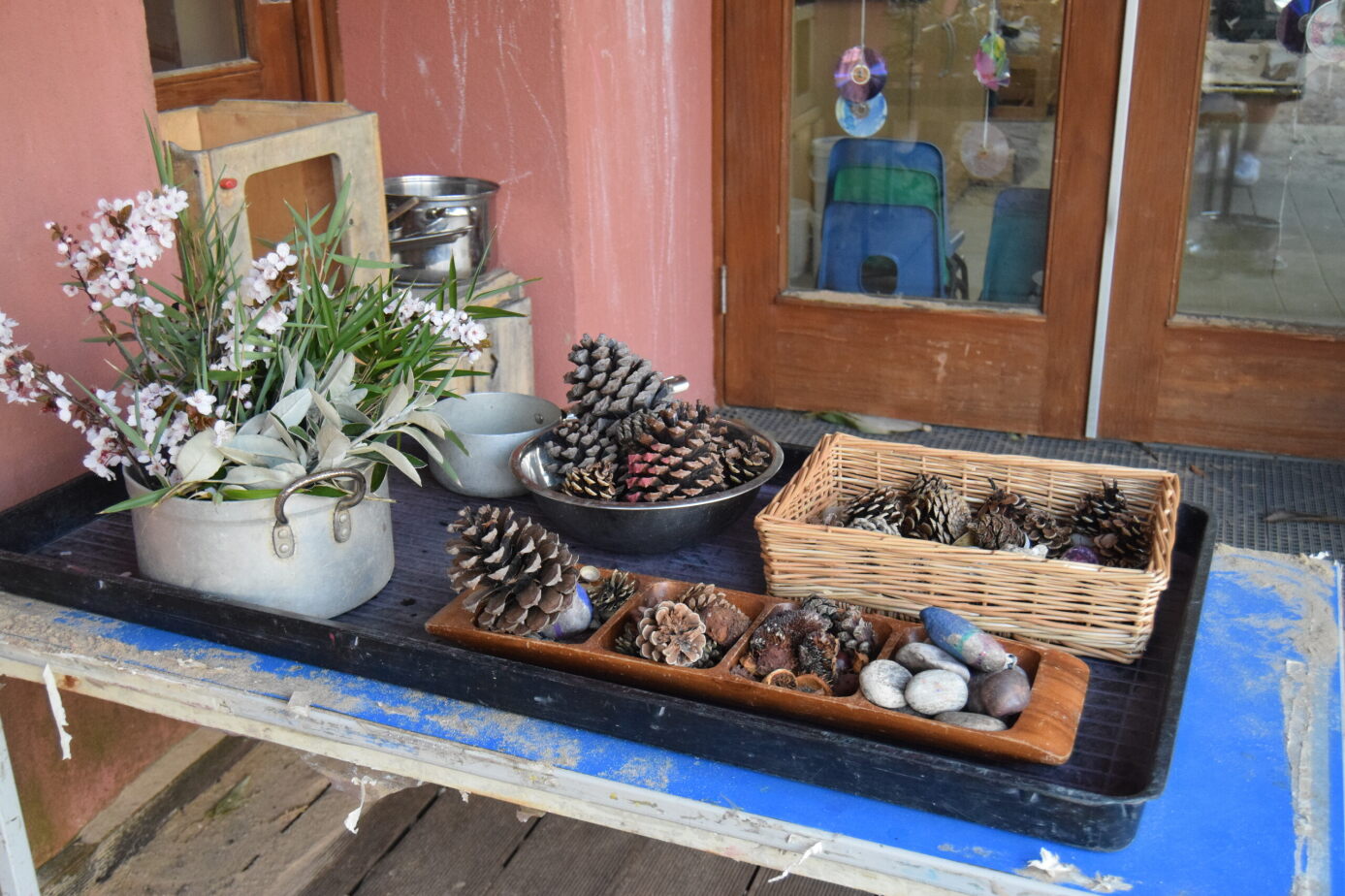
You’ll need:
- an area that will be suitable to arrange a selection of natural or loose parts. Check all of the resources are suitable and safe to use such as empty containers, baskets, boxes, buckets and tubes ranging in shape and size
- natural items like leaves, petals, conkers, fir cones, shells, pebbles, sticks, feathers and acorns
- chalk to draw on the ground
- patterns in your immediate outside area like bricks in a wall, lines on pavements, petals on flowers, veins on leaves or fencing
Allow the children the freedom to explore the resources. Provide a range of containers so they can sort resources into different sets.
Point out the patterns in the items. For example, leaves and petals have interesting repeated pattern shapes. So do fir cones, shells or trees. Children under 2 could examine a leaf or a petal.
You could provide a commentary using language to describe the shapes of what things the children are looking at, such as circular, square, dots or stripes.
It may help to provide chalked boxes for children to make their own collections with natural objects arranged in various ways.
How this activity links to the other areas of learning
Children are given the opportunity to be creative, design their own patterns (expressive arts and design). They’ll learn about the natural world (understanding of the world). They’ll discuss and express their understanding of patterns (communication and language). By spotting patterns they’ll begin to identify different mathematical relationships (mathematics).
Playing skittles
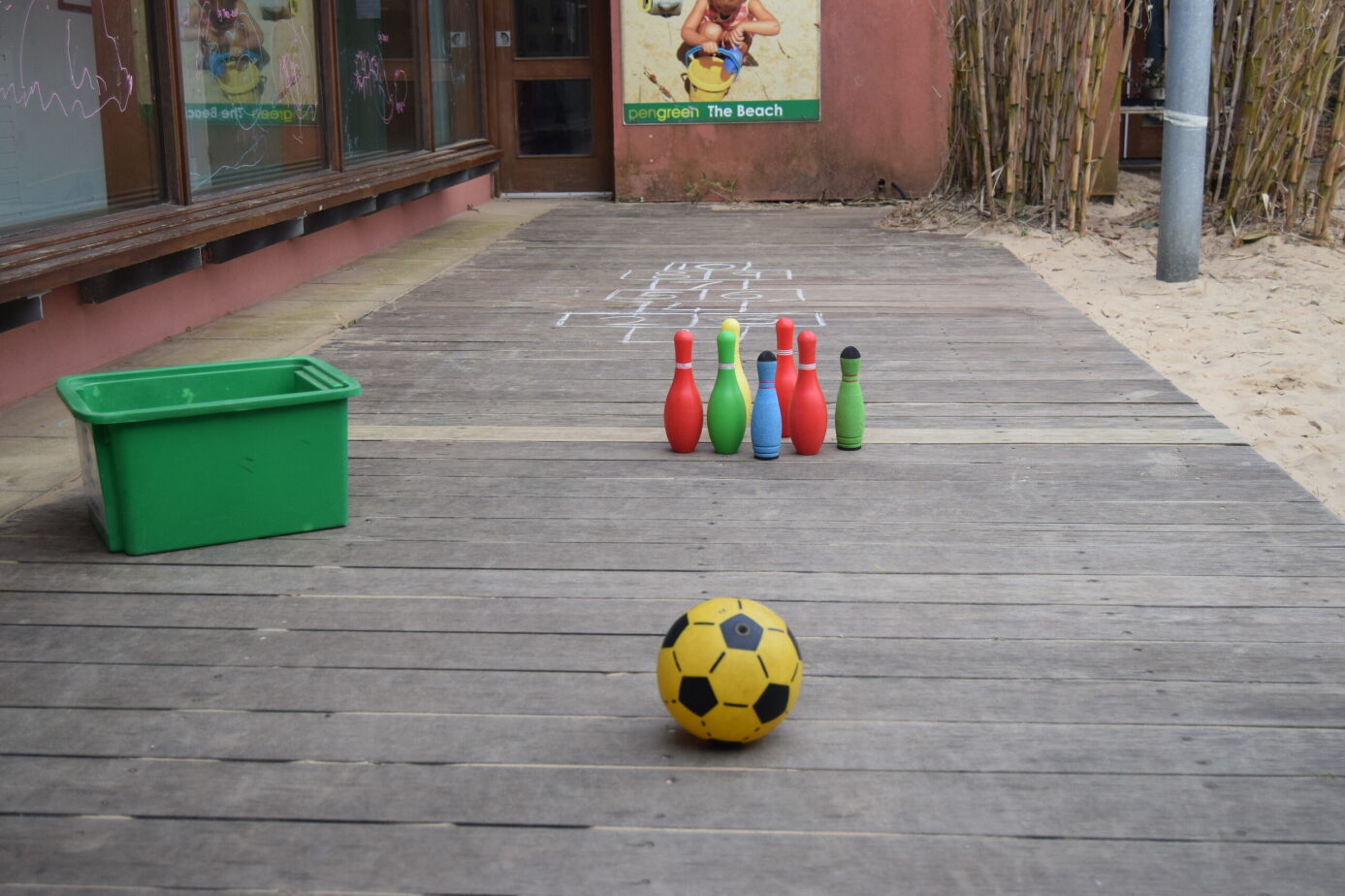
You’ll need:
- skittles, either bought or home-made
- balls in different sizes and weights
- paper and pen
- small whiteboard and pen
- chalk and chalkboard
Choose an area that has a flat surface, inside or outside, and mark out the game area.
Set up a recording station to collate scores, like a blackboard, and discuss the rules with the children. Show them how to set up the skittles. Show them where to stand. Explain to them how to count scores, take turns and how to record the scores.
Show the children how to roll the ball and discuss how to count the skittles when they have been knocked over. Talk with the children about how they could record their scores and discuss how turn-taking works.
Set up the skittles ready for play and have a practice run first.
How this activity links to the other areas of learning
Children will discuss, negotiate and express their understanding of the rules of the game (communication and language). Children can learn physical coordination by playing the game (physical development). The activity strengthens all the maths areas (mathematics).
Other activities
Help children with finding and learning more about patterns on the Nrich site.
CBeebies Numberblocks have some useful activities for young children that encourage the use of patterns and connections.
What other nurseries and childminders are doing
“When noticing and identifying patterns we talk about shapes, colours and numbers to start to make connections. We look at which shapes fit within one another. When setting up our environment we carefully select images, photographs and factual books for children to access to support their learning of natural patterns and architecture in our local community and beyond. The rhythm of the day plays a significant part in patterns and this can be used to help children make sense of their day. Patterns come in a variety of forms and can allow children the chance to explore, experiment and discover the world around them. The children always have access to materials such as building blocks (of different sizes), train tracks, construction resources and smaller parts (mosaic tiles). Using these materials, we play alongside the children and help them in identifying the patterns and connections that surround them.”
Kerry, Redcliffe Nursery School, Bristol.
Summary
- Introduce children to visual patterns in fabrics and materials and show them patterns in the natural environment.
- Use stories, rhymes and songs to help them understand how patterns and sequences occur in speech and music.
- Use the routines and sequences of the day to show them how patterns are repeated in time.
- Use appropriate language to support children’s understanding of patterns and connections.
- Understanding repeated patterns and connections is an important foundation for learning maths in reception.
Next steps
- If possible take opportunities to visit other settings where maths is a strength, this will benefit you and the children.
- Think about introducing more resources like interesting found materials showing patterns.
- Taking the children on nature walks is a good way to show them patterns in the natural environment.
- Review your curriculum to ensure you cover the requirements in the EYFS for this area of learning.